FIELD NOTE · 16 MIN READ
I Wired an LLM to a Fly's Brain
AI agents usually inherit interfaces whose meanings have already been decided. I wanted to know what happens when the actions exist before the abstractions.

Essays and notes about AI systems, judgment, and practical use.
48 entries
AI agents usually inherit interfaces whose meanings have already been decided. I wanted to know what happens when the actions exist before the abstractions.
AI’s frontier is becoming more governed and expensive in the West, even as China and open-weight models commoditize intelligence, lower prices and force competition back into the market.

Managed services has spent decades accumulating customer experience without allowing that experience to compound. Being AI-first means changing that; building operational intelligence that learns the customer, remembers what worked, understands what failed, and lets yesterday’s operations improve tomorrow’s decisions.

Several earlier arguments about work, sovereignty, and AI are becoming less speculative as events catch up. The question is whether we can notice the present before consensus names it.

Enterprise security has spent decades protecting credentials. Agentic AI shifts the problem from secrets at rest to authority in motion, forcing us to rethink identity, delegation, and execution in autonomous systems.

Alex Karp’s critique matters because it comes from inside the AI wave: tokens are not yield, usage is not value, and enterprise AI must be judged by the consequences it produces.

The queue was never just a process detail. It was the real operating model: a system for turning uncertainty into controlled human coordination.

AI is too consequential to be left to enthusiasts. The conversation needs less prophecy, more proof, and a lot more precision.

AI does not persuade; it concludes, removing the interval in which doubt might have lived. What remains is fluency mistaken for truth, and consensus reduced to the absence of difference.

As AI makes execution cheaper, direction matters more: what to build, whom to serve, and whether the problem is worth solving.

AI models may reinforce what people are most likely to accept, strengthening existing beliefs and collective overconfidence.

At the AI Summit, the sameness of AI products and marketing is hard to miss. Credibility will belong to companies with sharper, truer, more specific stories.
Markets are pricing AI on a future shaped by foundational model capability and rapid workflow innovation. As leaderboards continue to shift, the case for broad AI pessimism remains premature.


AI can make young engineers faster without making them better.
AI can execute flawlessly—but it can’t care. The next era belongs to those who question the premise, slow down when speed feels wrong, and carry culture through automation.
Companies can fall into an AI loop of modernization and cost savings. Breaking it requires wanting more: resilience, intelligence, and speed.

Distribution is no longer a durable moat. The next wave will win with modular, AI-native technology, outcome-based pricing, and domain-specific units of intelligence that augment higher-value work.
AI is making people-heavy operations less necessary. Indian IT firms must shift from billing for headcount and hours to pricing technology margins, outcomes, and capabilities that expand what clients can do.
Data centers are the new factories, and compute is becoming a foundation of sovereignty. India must build its own AI backbone or risk renting its digital destiny from others.
Cheaper code and faster delivery do not guarantee a useful product. Conviction grounded in customer understanding gives the work direction.
Most festivals celebrate the victors. Onam is.
AI did not erase research’s value; it removed the scapegoat. Gartner’s deeper challenge is a generation of builders acting on conviction, accepting failure, and refusing to outsource accountability.
As Microland turned 36, Nextronauts brought together hands-on exploration, discovery, and imagination—reminding us that curiosity and possibility are the real engines of progress.

AI hype can make the job market feel overwhelming. Build genuine skill, pursue valuable work, and stay grounded in fundamentals instead of chasing every shiny narrative.
Foundation models can swallow generic work, but they cannot own every niche. Startups win by being specific, trusted, and hard to copy.

AI-first operations integrate intelligence into existing workflows, combining human judgment, modular tools, and governance without requiring a wholesale replacement of the stack.
Your feed isn’t a mirror of reality; it’s a version of reality chosen for you by an algorithm that decides which voices rise and which quietly disappear.
In an age of agents, the advantage is not pretending humans are obsolete. It is building systems that still care about judgment, ownership, and taste.

Low-code can accelerate prototypes; it cannot repeal complexity. Real enterprise software still needs engineers who understand consequences.

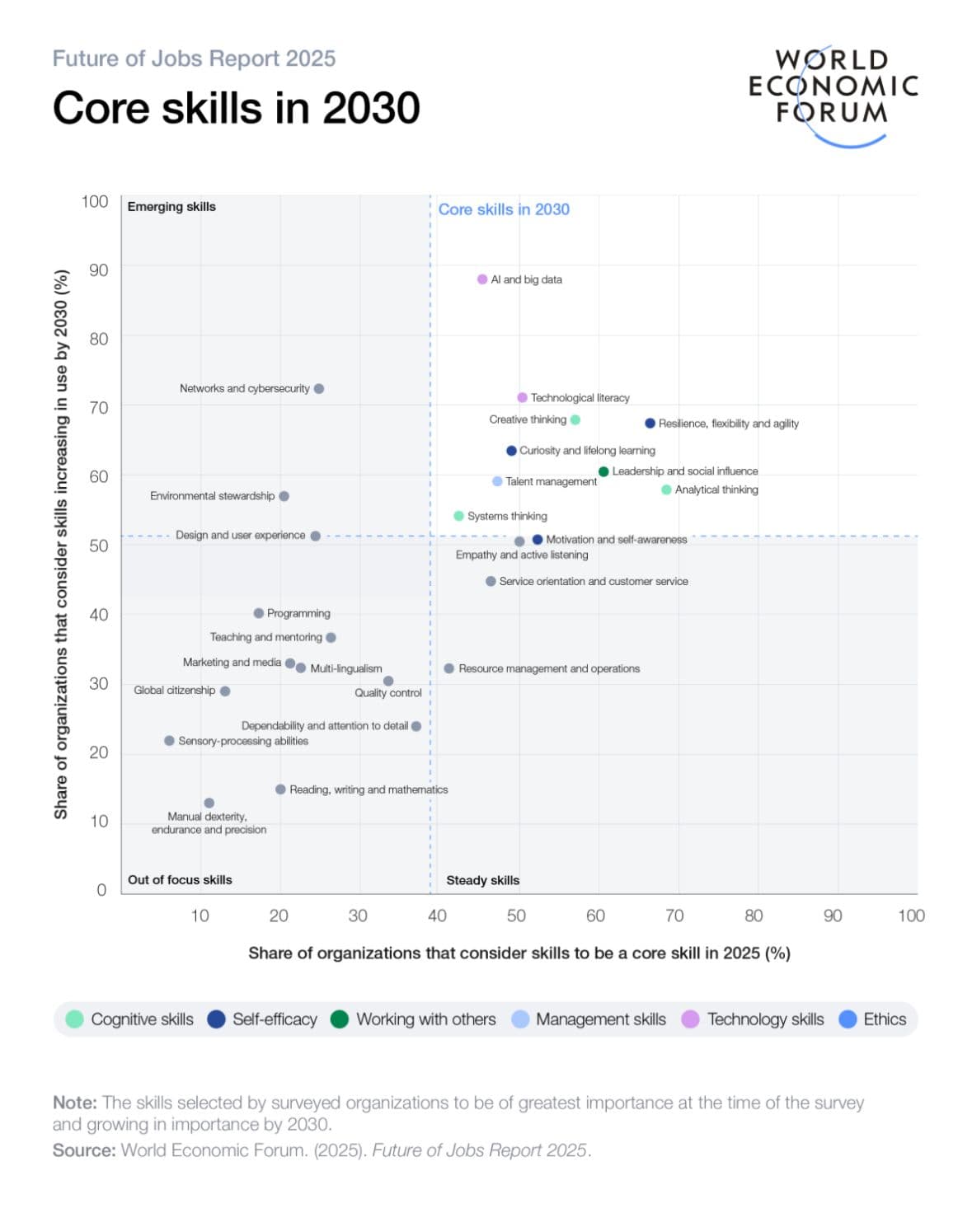
The future of work may favor AI, resilience, and creativity, but those skills depend on the basics: reading, writing, mathematics, reasoning, and the ability to teach others.
The money in AI is not where the models are smartest. It is where the model gets embedded into a workflow someone will actually pay for.

An AI-first partner should change how work happens, not just sell clever demos. If it does not reshape the operating model, it is not AI-first.

When AI answers before you search, truth gets mediated by a model. The new information order will reward trust, provenance, and verification.

This is not a fight over search. It is a fight over where users start, how they decide, and who owns intent.

The next leap in AI will not come from a bigger model alone. It will come from interfaces that make intelligence feel obvious, useful, and inevitable.

You do not need a perfect stack to start using AI in operations. You need a real problem, a noisy system, and the courage to attack both.

AI does not just make markets bigger; it compresses the margins that once protected incumbents.

As AI raises the stakes, infrastructure stops being background plumbing and becomes the new guardian of trust, uptime, and control.

AI becomes valuable when it stops being impressive and starts being useful. Cool demos do not pay bills.

Do not compete with AI on output. Build the human strengths it cannot imitate: judgment, initiative, and empathy.

Not every AI surge is a bubble. Some are real platform shifts wearing bubble-like clothes.

Entry-level tech work is not disappearing; it is changing shape. The future belongs to people who can learn faster than tools can automate.

Deep-tech AI wins headlines; applied AI wins outcomes. The ethics question is not whether AI is powerful, but who gets to use that power, and how.

AI hype is real, but so is the underlying shift. The hard part is separating durable capability from the market's favorite storyline.

AI's real power is not shaving costs off old businesses. It is inventing new ones that were impossible when intelligence was scarce.